

 Facebook
 X
 Pinterest
 Copy Link
Midland MI Real Estate: What Buyers Need to Know in 2026
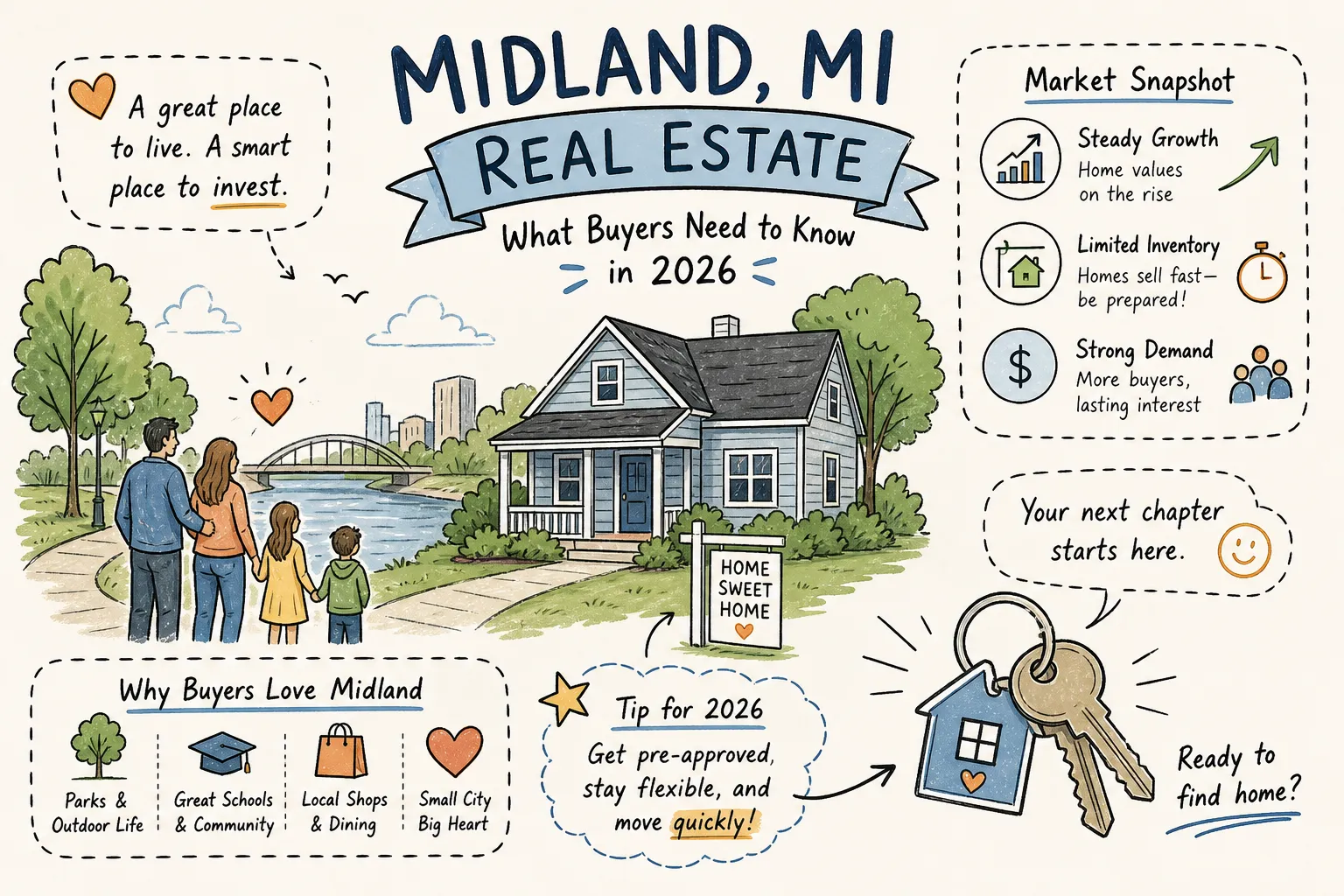
Midland, MI real estate in 2026 offers something that’s genuinely hard to manufacture in most mid-Michigan markets: a stable housing market, highly rated schools, and a lifestyle that consistently surprises first-time visitors. While Bay City earns attention for its waterfront history and Saginaw attracts budget-conscious buyers with lower entry points, Midland keeps delivering. With roughly 289 active homes on the market and a median listing price near $250,000 as of mid-2026, buyers here have real options without the volatility you sometimes see in larger Michigan metros.
I work with buyers across all three Tri-Cities as a CENTURY 21 Signature Realty agent, and one of the most common conversations I have goes something like this: “We’re looking at Bay City and Midland, but we’re not sure which way to go.” That comparison deserves a real answer, not a vague “it depends.” This guide walks through what the Midland, MI real estate market actually looks like in 2026, which neighborhoods fit which budgets, and how Midland stacks up against its neighbors so you can make a confident decision before you ever schedule a showing.
What sets Midland apart from the rest of the Tri-Cities
Bay City leans hard into its waterfront history, and Saginaw draws buyers who need to stretch a budget as far as it will go. Midland carved out a completely different niche: a clean, well-planned city anchored by Dow Chemical’s legacy and a culture of sustained public investment. The commercial corridors are noticeably cleaner, the trail system is extensive, and there’s an arts infrastructure here that most cities twice Midland’s size would envy. These aren’t abstract points. They’re the things buyers comment on after their first drive through town.
Why the Dow Chemical heritage still shapes home values today
Dow’s century-long presence in Midland created something rare: a stable, well-employed local population that sustained consistent demand for quality housing. That economic backbone funded strong schools, well-maintained parks, and decades of neighborhood investment. It also historically buffered Midland from the sharper price swings that hit other mid-Michigan communities during economic downturns, one reason this market tends to attract families thinking long-term rather than buyers chasing a quick flip.
Lifestyle factors buyers notice once they visit
The Tridge, Midland’s iconic three-legged pedestrian bridge where the Tittabawassee and Chippewa rivers meet, has become a genuine community landmark that draws residents year-round for walks, picnics, and events. Chippewa Nature Center adds hundreds of acres of trails and wildlife programming. Dow Gardens and the Whiting Forest canopy walk are destination-level attractions set within a walkable community. The Midland Center for the Arts brings theater, music, and exhibitions to a city of about 40,000. Every time I show Midland to a buyer relocating from Lansing or Flint, the reaction is the same: it reframes the whole conversation about where to buy.
Midland, MI real estate market snapshot for 2026
The two numbers that anchor any Midland home search right now are 289 active listings and a median listing price near $250,000. Median sale price data varies slightly across platforms: Redfin reported $254,861 in June 2026, while Zillow’s typical home value sits at $254,175. That range reflects methodology differences more than a conflicted market. Buyers shopping in the mid-$250K range have real options and a clear picture of what that budget gets them in Midland homes for sale.
What the current inventory level means for buyers right now
With 289 active homes across price points, this is not a flooded market, but it’s not an inventory crisis either. Buyers have genuine choices and enough time to evaluate them without panicking. The average days on market hovers around 28 to 34 days depending on the source, which tells you homes are moving at a measured pace rather than being snatched up in hours. That pace gives buyers room to think, inspect, and negotiate without the frenzied offer dynamics that defined Michigan markets a few years back.
Price trends: flat, rising, or somewhere in between?
Year-over-year price change figures range from -2% (Redfin) to +7.8% (Zillow), which sounds contradictory until you understand that each platform measures slightly different things at different points in time. Realtor.com, splitting the difference, shows a modest +0.4% increase. The practical takeaway is that Midland home values have held steady and shown modest appreciation, making this a stable buy rather than a speculative risk. That kind of consistency is what draws long-term buyers to this market year after year.
Midland, MI real estate neighborhoods worth knowing
Midland’s neighborhoods sort themselves pretty naturally by price band, which makes it easier for buyers to self-select before ever stepping into a car. The west and southwest sides concentrate the higher-end inventory; the historic districts offer character at mid-range prices; and the eastern and northern neighborhoods give entry-level buyers a way into Midland at a more accessible price point. Having shown homes throughout all of these areas, I can tell you that the block-level differences matter as much as the neighborhood name on a map.
The higher-end west side and historic districts
The West Main Street Historic District runs from the low $200Ks up to $600K or more, with architectural detail and neighborhood character that attract buyers willing to pay a premium for something distinct. The Center Avenue Historic District clusters around a $249K median, offering a more accessible entry into Midland’s established neighborhoods. The southwest side is where the city’s highest prices tend to concentrate, supported by proximity to strong schools and well-maintained streets. These areas draw professionals, families upgrading from a starter home, and buyers relocating from larger Michigan metros who want lasting quality.
More affordable neighborhoods for entry-level and budget-conscious buyers
Covenant, Northmoor, and Adams Boulevard give buyers a way into Midland at substantially lower price points, with typical values ranging from roughly $57K to $110K depending on the specific sub-area. These neighborhoods vary in condition and character, and that’s exactly the kind of nuance a local agent needs to walk you through. A listing at $85K in Northmoor can represent strong value or a significant project depending on the block. Generalizing from a neighborhood name alone will cost you either money or a missed opportunity.
Schools and community draws fueling buyer demand in Midland
For families comparing homes in Midland, MI to Bay City or Saginaw, school quality frequently becomes the deciding factor. Midland High School carries a 9/10 rating, Jefferson Middle School holds a 9/10, Woodcrest Elementary scores a 9/10, and H.H. Dow High School comes in at 8 to 9 out of 10 depending on the rating source. Bay City’s school district sits around a 5/10 overall by most measures. These numbers consistently push family buyers toward Midland even when Bay City or Saginaw might fit their budget more comfortably at first glance.
School ratings that move the needle for families
A 9/10 school system in a market where median prices sit in the mid-$250Ks is unusual. In most Michigan metros, that caliber of public school access comes attached to significantly higher home prices. Midland’s combination of school quality and price point is one of its clearest competitive advantages, and it shows up directly in buyer demand from families who might otherwise look at higher-cost suburbs near Lansing or Flint. Schools move markets, and Midland’s ratings are doing exactly that.
Outdoor amenities and community infrastructure
Beyond schools, Midland packs an unusually dense set of amenities into a compact city. The Pere Marquette Rail Trail connects outdoor recreation to the broader region. The Midland City Forest handles mountain biking and winter trails. The Greater Midland Community Center adds indoor ice, tennis, pools, and fitness facilities. Dow Diamond gives the city a minor league baseball anchor. That last one matters more than it sounds, most communities of similar size simply don’t have it. Taken together, these amenities consistently surprise buyers who expected a quiet small town and found something with a much fuller quality-of-life profile.
How Midland compares to Bay City and Saginaw for today’s buyers
This comparison comes up constantly, and it deserves a direct answer. Midland’s median listing price near $250,000 sits noticeably above Bay City’s range of roughly $127K to $150K. Saginaw’s median comes in lower still, around that same $150K range based on available data. The price gap is real, but so is what you’re getting for it. Midland buyers are generally purchasing into stronger school systems, more consistent neighborhood conditions, and a track record of steadier long-term value retention.
Price point reality check across all three cities
Bay City offers waterfront character, a growing downtown, and an appealing neighborhood feel at roughly half of Midland’s median price. Saginaw offers the lowest entry-level prices in the Tri-Cities, with inventory that works well for investors and first-time buyers who need to maximize purchasing power. Midland’s higher price tag reflects what the market has consistently valued over time: strong schools, quality infrastructure, and lifestyle amenities that support long-term demand. None of these cities is a bad choice. They’re just right for different buyers.
Which buyer profile fits which city
Families prioritizing school district and long-term stability tend to land in Midland. Buyers drawn to walkable waterfront character, neighborhood history, and a midpoint price tend to gravitate toward Bay City. Investors and buyers working with tighter budgets, including many first-time buyers, often find Saginaw’s market a better fit. Knowing which profile matches your priorities is the fastest way to narrow your search and stop second-guessing every listing across all three cities at once.
How a Tri-Cities specialist helps you find the right fit
Working with one agent who knows all three markets is a different experience than starting over with a new agent every time you shift your search from one city to another. I’m active across Midland, Bay City, and Saginaw, which means when a client asks me to compare a Midland listing to something in Bay City, I’m not guessing. I know both markets, both neighborhoods, and both sets of trade-offs from actual transactions, not from a zip code map.
Why local knowledge makes a real difference in a Tri-Cities search
A buyer comparing all three cities needs an agent who can give them a straight answer about each one without steering them toward whichever neighborhood that agent happens to specialize in. That comparative perspective is one of the most practical things I bring to a buyer relationship. If Midland is the right fit for your family, I’ll tell you that clearly and show you why. If Bay City’s price point and waterfront access serve your goals better, that’s where we’ll focus. The goal is your best outcome, not my convenience.
What working with Allison Thurston actually looks like
As a solo agent with CENTURY 21 Signature Realty, I work directly with every client. You won’t get passed to a team member or assistant when you reach out. Whether you’re browsing current Midland, MI real estate listings on the MLS, using the Drive Time search tool to figure out which neighborhoods fit your commute, or ready to schedule a showing this weekend, you’re contacting me directly. That direct accessibility matters when you’re making a decision this significant, and it’s something I take seriously with every buyer I work with.
The bottom line on Midland, MI real estate in 2026
Midland, MI real estate earns serious consideration from buyers who want a stable market, strong schools, and a quality-of-life profile that holds up under scrutiny. With roughly 289 active homes, a median near $250,000, and a school system rated consistently at the top of mid-Michigan, this market delivers a combination that’s hard to find at this price point. Homes are moving in about 28 to 34 days on average, which means buyers have room to be thoughtful without rushing every decision.
Comparing Midland to Bay City and Saginaw is a smart move before committing to any of them. Having a Tri-Cities specialist walk you through all three markets side by side cuts the time between browsing and committing. If you’re ready to explore current Midland homes for sale, run the numbers on a specific neighborhood, or just talk through where Midland fits in your search, reach out directly to Allison Thurston at CENTURY 21 Signature Realty. I’m happy to be your first call.


